

 Locations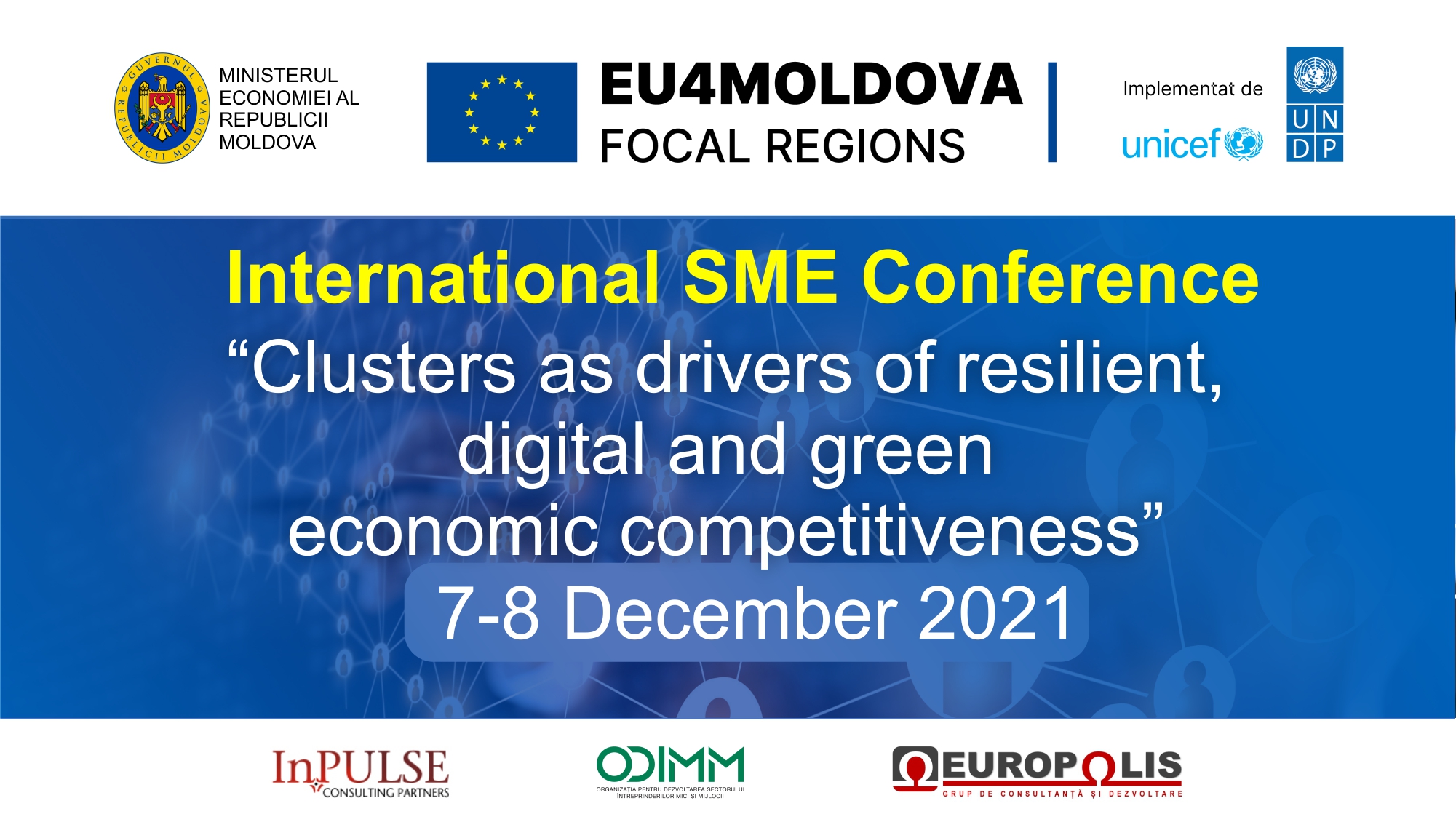
Clusters as drivers of green, digital, and resilient economic competitiveness, their role in triggering and carrying out processes in a circular economy were the subjects of the International Conference of Small and Medium Enterprises (SMEs) 2021, conducted online during 7-8 December. The messages of the speakers and participants highlighted that clustering stimulates economic development, revitalizes industrial sectors and provides the necessary framework for regional development, research and innovation. The development of clusters in the Republic of Moldova is one of the main elements for strengthening regional competitiveness, and the European Union, within the “EU4Moldova: Focal Regions” Programme will come in 2022 with financial instruments to develop more clusters in the Cahul and Ungheni regions. The Programme is implemented by UNDP and UNICEF.
In the context of COVID-19 crisis, clusters have an essential role and there is need of strong commitment, coordinated efforts and actions by all stakeholders to establish solid partnerships for their creation and further development, said Sergiu Gaibu, the Minister of Economy, in his opening remarks to the event: “Clusters have shown performance in many countries, because they have different configurations, and the Republic of Moldova should find its own high-performance and competitive models both on the domestic and international market. Clusters in rural or agricultural areas will be different from those in the field of innovation or information technology. For this reason, the Ministry of Economy will support the piloting of cluster models until we identify the most successful one to be replicated and widely used in the economy.”
The European Union supports and strengthens the development of clusters by providing financial assistance for the purchase of machinery and equipment, as well as technical assistance to increase the capacity of several clusters in the Cahul and Ungheni regions.
The Deputy Head of Operations at EU Delegation to the Republic of Moldova, Gintautas Baranauskas mentioned on the occasion: “This event organised in cooperation with the EU Focal Regions pPogramme put the focus on the role of clusters as drivers of green, digital and resilient economic competitiveness in the Republic of Moldova. That is absolutely key and I would like to highlight that the Focal Regions Programme is a transformative green agenda that, at the local level, is replicating the European Green Deal approach. It is now important to scale up the action as soon as possible. The European Union is already providing the necessary financial support to reinforce local value chains and clusters in Cahul and Ungheni regions. This is a tangible support to boost the economic recovery and improve the business environment with the ultimate objective to create green and long-lasting economic development.”
Dima Al-Khatib, UNDP Resident Representative to the Republic of Moldova, said: “I am confident that the discussions during this conference will set a good momentum and foundation for Republic of Moldova, particular for Cahul and Ungheni Regions to catalyze investments based on circular economy principles, innovation, participatory planning; will provide not only valuable knowledge and innovation insights but also opportunities for partnerships between a variety of public and private sector entities, from the country and abroad.”
According to the experts participating in the conference, international experience shows that the association of manufacturing companies, suppliers and state and private institutions operating in a certain sector (creating cluster networks) increases technological performance and productivity, contributing to the competitiveness of companies, expanding the market and increasing visibility.
The event tackled the new models of collaboration that would accelerate economic development by revitalizing key sectors and providing a necessary environment for regional research, innovation and development. In this regard, more attention needs to been paid to opportunities to incorporate the dimensions of "circular economy" and "digitalization" in the context of clusters’ development.
The sustainable development of clusters and the increase of their international competitiveness should be as well the result of the development and application of new technologies and principles, by updating the technological process, while respecting the principles of environmental protection.
The International Conference of Small and Medium Enterprises brought together representatives of the Government, development partners, business and academia, research, public administration, a total of 300 participants from the Republic of Moldova and from abroad.
The conference was organized by the Ministry of Economy of the Republic of Moldova, Organization for Small and Medium Enterprises Sector Development (ODIMM) and the Programme “EU4Moldova: Focal Regions”, with the financial support of the European Union and implemented by the United Nations Development Programme (UNDP) and the United Nations Children's Fund (UNICEF), in partnership with the Europolis and InPulse organizations.


